.png?w=460&h=118)
Quick Answer
IP ratings indicate protection against dust and water. IP20 suits dry indoor spaces, IP44 works for bathrooms and kitchens, IP65 for sheltered outdoors, and IP66 for fully exposed outdoor locations.
Choosing the right IP rating for your lighting is crucial for both safety and longevity. These seemingly random numbers actually tell you exactly how protected your lights are against dust and water. Installing fixtures with inappropriate ratings can lead to electrical failures, short circuits, and even fire hazards. This guide will help you select the appropriate IP rating for every area of your home.
Key Takeaways:
- First digits (0-6) indicate protection against solids, while second digits (0-8) show water resistance; higher numbers mean better protection.
- IP20 is for dry indoor areas only, IP44 suits bathrooms and kitchens, IP65 works for sheltered outdoor spaces, and IP66 is necessary for fully exposed outdoor settings.
- UK bathroom regulations require specific IP ratings by zone, IP67 for inside baths/showers, IP45/IP65 for directly above, and IP44 for surrounding areas.
What Are IP Ratings?
IP stands for Ingress Protection, a standard adopted in the UK as BS EN 60529. These ratings indicate how well electrical enclosures resist intrusion from solids and liquids.
The rating consists of two numbers. The first digit (0-6) shows protection against solid objects like dust and fingers. The second digit (0-8) indicates resistance to moisture and water. Higher numbers mean better protection.
For example, in IP44, the first '4' means it's protected against objects larger than 1mm, while the second '4' indicates protection against water splashing from any direction.
Understanding these ratings helps prevent electrical damage and ensures your lighting installations remain safe and functional for years.
IP20 vs IP44 vs IP65 vs IP66 - What's the Difference?
Each IP rating offers different levels of protection suitable for specific environments in your home.
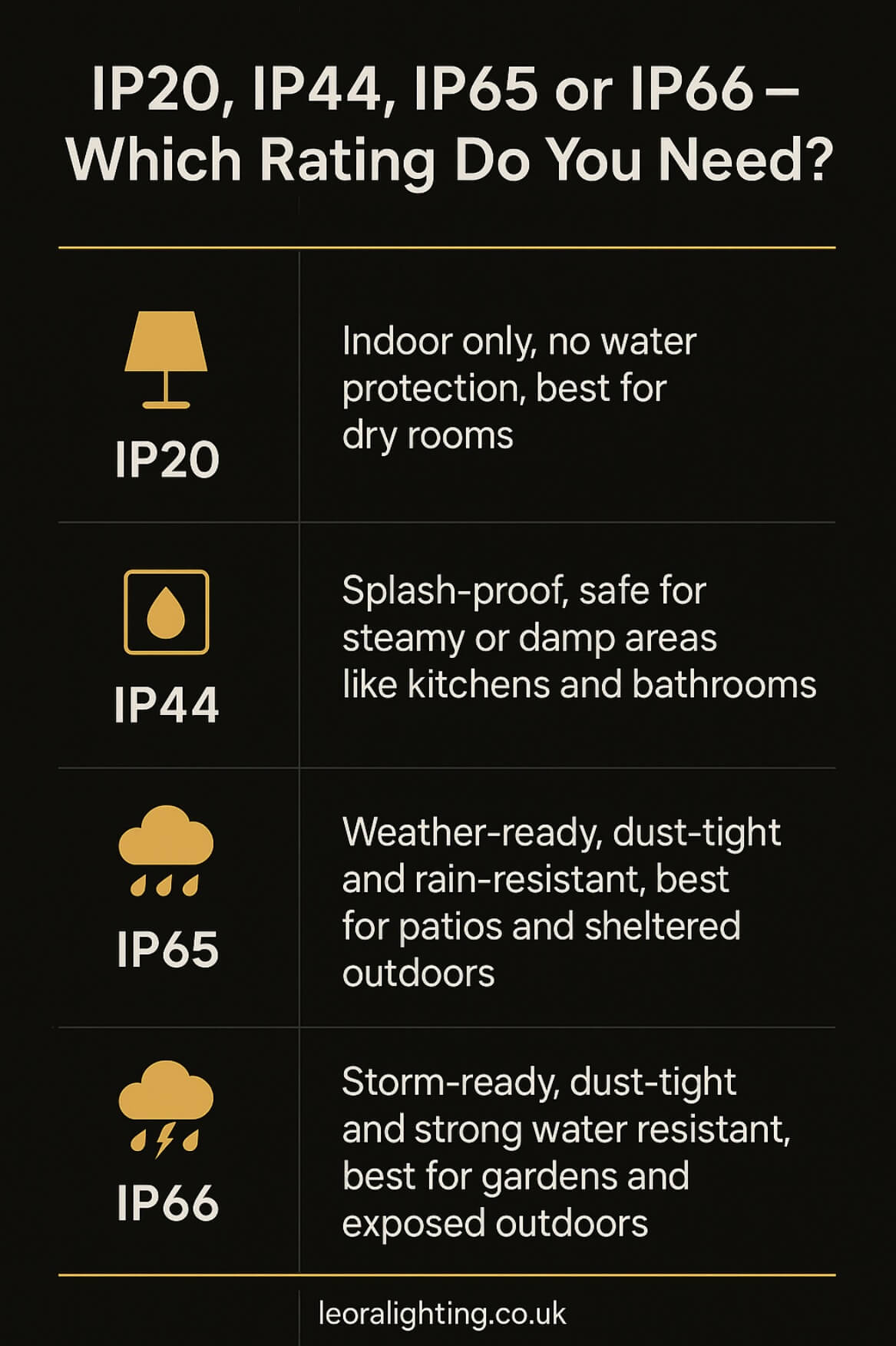
- IP20 protects against objects >12.5mm, but offers no water protection. IP20 fixtures are standard for most indoor lighting in dry areas.
- IP44 keeps out tools, wires, and most insects, objects >1mm, while resisting water splashed from any direction. IP44-rated lighting works well in moisture-prone indoor areas.
- IP65 is completely dust-tight and protects against low-pressure water jets. IP65 products suit sheltered outdoor settings.
- IP66 offers complete dust protection and resists powerful water jets. IP66 lighting stands up to exposed outdoor conditions.
Where to Use Each IP Rating at Home
Indoor Locations
- Bathrooms: UK bathroom zones require specific IP ratings for safety. Remember that steam and condensation can affect electrical fixtures even outside these zones.
- Zone 0 (inside bath/shower): IP67 required
- Zone 1 (above bath up to 2.25m): IP45 minimum, IP65 preferred
- Zone 2 (60cm outside Zone 1): IP44 adequate
- Outside zones: IP20 acceptable but IP44 safer
- Kitchens: Kitchens combine heat, steam, and water splashes, requiring careful IP rating selection. Near sinks and hobs, IP44 fixtures provide necessary splash protection. For ceiling fixtures away from water sources, IP20 is typically sufficient. Under-cabinet lighting installed near water should be IP44 minimum. Many homeowners overlook the steam factor in kitchens. Even without direct water contact, condensation can gradually damage inadequately protected fixtures.
- Living Areas: Standard living spaces without water exposure can safely use IP20 fixtures. These areas include lounges, dining rooms, and bedrooms. However, consider IP44 for areas near windows that might be opened during rain or rooms prone to condensation.
- Garages and Utility Rooms: Garages often experience temperature fluctuations and increased humidity. IP44 is recommended for general garage lighting. Utility rooms with washing machines or sinks need IP44 minimum, with IP65 preferred for areas directly above water sources.
Outdoor Locations
- Covered Patios and Porches: Well-sheltered areas might function with IP44, but IP65 provides better long-term protection against the elements. The UK's unpredictable weather makes IP65 a safer choice even for covered outdoor spaces.
- Gardens and Exposed Areas: Garden lighting should be IP65 minimum, while fully exposed fixtures benefit from IP66 protection. Ground-level lighting faces additional challenges from soil moisture and splashing, requiring IP66 or higher. The outdoor LED lighting market in the UK is growing rapidly, projected to reach £505 million by 2030, with public spaces accounting for 92% of the market volume.
Practical Uses of IP Ratings
|
Location |
Recommended Rating |
Practical Considerations |
|
Living room ceiling |
IP20 |
Standard indoor use, no moisture exposure |
|
Kitchen general lighting |
IP20-IP44 |
Higher rating near cooking/sink areas |
|
Kitchen over sink |
IP44 |
Protection from splashes and steam |
|
Bathroom vanity light |
IP44 |
Handles steam and occasional splashes |
|
Shower light |
IP65-IP67 |
Must withstand direct water exposure |
|
Covered patio |
IP44-IP65 |
Protected from rain but exposed to humidity |
|
Garden path lighting |
IP65 |
Handles rain and ground moisture |
|
Exposed garden spotlights |
IP66 |
Withstands heavy rain and weather |
|
Garden pond lighting |
IP67-IP68 |
Designed for immersion in water |
|
Garage lighting |
IP44-IP65 |
Depends on moisture levels and activities |
When Not to Use Each IP Rating
IP20 Limitations
- IP20 fixtures should never be used in bathrooms except in completely dry "outside zones." They're unsuitable near kitchen sinks, water sources, or steam-producing appliances.
- Using IP20 outdoors or in garages with moisture is asking for trouble. Many electrical failures stem from installing inadequate IP-rated products in damp environments.
IP44 Limitations
- While versatile, IP44 isn't adequate for exposed outdoor locations. Garden lighting directly exposed to heavy rain or ground moisture will fail prematurely with only IP44 protection.
- Areas with direct water contact, like near outdoor taps or under dripping eaves, need higher protection than IP44 can offer.
IP65/IP66 Considerations
- These higher ratings are rarely necessary for general indoor lighting. Using them everywhere would be overkill and unnecessarily expensive.
- They also tend to be bulkier and may not suit more delicate interior design schemes where aesthetics matter.
Conclusion
Choosing the right IP rating isn't about overcomplicating things. It's about matching the right protection to each environment in your home. The small initial investment in properly rated fixtures prevents costly replacements and potential safety risks down the line.
For bathrooms, remember the zoning rules. For kitchens, protect areas near water. And for outdoors, never compromise on quality.
At Leora Lighting, we offer a comprehensive range of lighting solutions with appropriate IP ratings for every area of your home. Our products are electrician-approved and carefully selected based on real-world performance.
Visit Leora Lighting today to explore our full range of waterproof and decorative lighting options, or contact us for expert advice on choosing the right IP rating for your specific needs.
FAQs
When should I upgrade to IP65 or IP66 for outdoor lighting?
Upgrade to IP65 when your outdoor lighting is partially sheltered but still exposed to rain. Choose IP66 for fully exposed locations or areas near sprinklers and pressure washers. The UK's rainy climate makes these ratings essential for most outdoor installations.
Is IP20 waterproof inside if it's just indoors?
No, IP20 offers no water protection whatsoever. Some homeowners mistakenly assume indoor fixtures are always safe. Even minimal moisture from steam or cooking fumes can damage IP20-rated products over time. Bathrooms and kitchens need higher ratings.
Can I use IP20 lighting in a kitchen or garage?
For kitchen ceilings away from cooking areas, IP20 may be acceptable. However, areas near sinks, hobs, or where steam rises need IP44 minimum. For garages, IP20 is generally insufficient due to humidity and dust. Choose IP44 or higher for garage lighting.
What's the minimum IP rating needed for bathroom use?
This depends on the bathroom zone. UK regulations require IP67 for Zone 0 (inside bath/shower), IP45 minimum for Zone 1 (area above bath), and IP44 for Zone 2 (area surrounding Zone 1). Outside these zones, IP20 is permitted, but IP44 offers better protection.
Do IP ratings degrade over time?
Yes, protection levels can deteriorate with age and environmental exposure. Seals wear out, housings crack, and gaskets degrade. Outdoor fittings should be inspected every 2-3 years. Replace any lighting showing signs of water ingress to maintain safety standards.
Sources