.png?w=460&h=118)
.jpg?w=1403&h=932)
Quick Answer
Lux measures light intensity at a surface, while lumens indicate total light output. Different rooms need specific brightness levels—kitchens require 500-700 lux, living rooms 100-300 lux, and bedrooms 100-150 lux.
Choosing the right brightness for your home lighting can feel like solving a puzzle. What's the difference between lux and lumens? How bright should your kitchen be compared to your bedroom? This guide cuts through the confusion with practical advice for every room in your UK home, helping you create spaces that are properly lit for both function and mood.
Key Takeaways
- Different rooms require specific light levels: kitchens need 500-700 lux for safe food preparation, living rooms 100-300 lux for versatility, and bedrooms 100-150 lux for relaxation.
- Lumens measure a light source's total output, while lux (lumens per square meter) indicates how bright a surface appears—making both measurements essential for proper lighting design.
- Your lighting needs change throughout the day and as you age, with brighter, cooler light improving morning productivity and warmer, dimmer light in the evening supporting better sleep.
What's the Difference Between Lux and Lumens?
.jpg?w=1402&h=2105)
Remember when we used to shop for light bulbs based on watts? Those days are gone. With energy-efficient LED lighting, watts only tell you how much power a bulb uses, not how bright it is. Enter lumens and lux – the proper measurements for brightness.
- Lumens (lm) measure the total amount of light produced by a source. Think of it as the raw output of brightness coming from your bulb in all directions. The higher the lumens, the brighter the light.
- Lux (lx) measures how that light spreads across your space – specifically, it's lumens per square meter. It tells you how bright a surface will actually appear when lit.
Here's a simple way to think about it: If you have a torch with 1000 lumens, that's its total light output. Shine it on a small area, and you might get 1000 lux. Spread that same light across a larger room, and you might only get 100 lux.
Under UK Building Regulations (Part L1A), at least 75% of fixed internal lighting in new homes must achieve 75 lumens per circuit-watt or better. This focuses on energy efficiency rather than brightness, but it's worth knowing when upgrading your lighting.
|
Aspect |
Lumens (lm) |
Lux (lx) |
|
Measures |
Total light output from source |
Light intensity at a surface |
|
Changes with distance |
No |
Yes (decreases with distance) |
|
Typical LED bulb |
400-800 lm |
Depends on room size |
|
Useful for |
Comparing bulb brightness |
Planning room lighting levels |
When shopping for our ceiling lights, you'll see lumens listed on the packaging. This tells you the bulb's brightness potential, while lux helps you determine if that bulb will provide enough light for your specific space.
How Bright Should Each Room Be?
Different activities require different light levels. Getting these right improves both functionality and atmosphere in your home.
Kitchen
Kitchen worktops need 500-700 lux for safe food preparation and detailed tasks. Poor lighting here can lead to accidents and eyestrain. Quality ceiling lights combined with under-cabinet lighting work best for even illumination across worktops.
Living Room
Living rooms benefit from layered lighting with 100-300 lux, varying between relaxation and activity zones. Consider 150 lux for general use, with additional task lighting for reading corners. Flexible options like floor lamps allow you to adjust lighting for different activities and times of day.
Bathroom
Bathrooms require 300-500 lux overall, with additional task lighting around mirrors for grooming. Proper lighting here reduces the risk of slips and provides accurate lighting for morning routines.
Bedroom
Bedrooms need gentle lighting around 100-150 lux for comfortable evening relaxation. Bedside table lamps with warm light create a peaceful environment that won't interfere with sleep hormones.
Reading Areas
Dedicated reading spaces need approximately 400 lux to prevent eye strain during extended reading sessions. Position task lighting to shine over your shoulder to avoid glare on pages or screens.
Hallways
Hallways require 75-150 lux for safe navigation. Since these spaces connect rooms, their lighting should bridge the brightness gap between areas. Stylish wall lights can provide both practical illumination and aesthetic appeal in corridors.
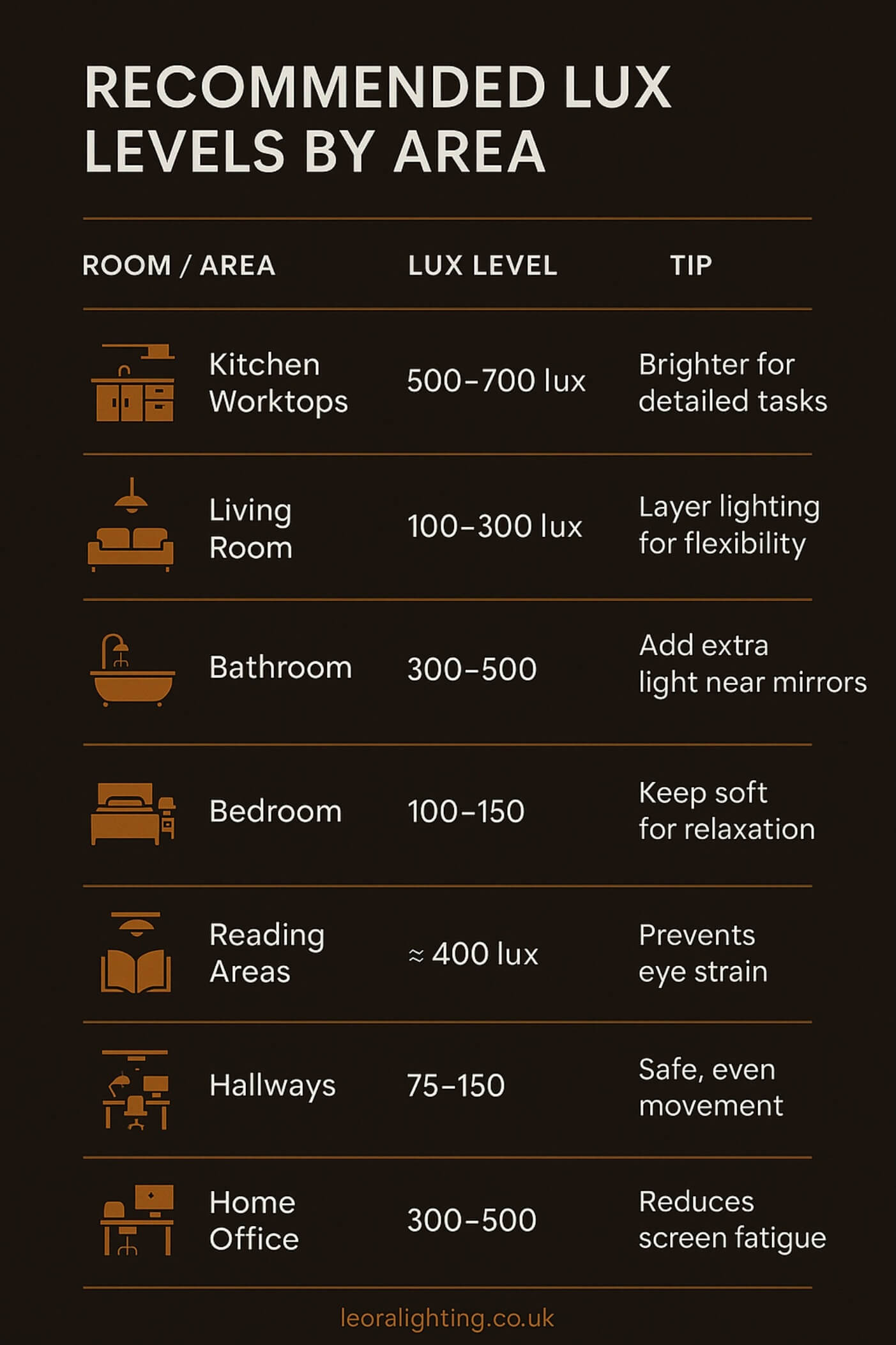
Factors like ceiling height, wall colour, and window placement also affect how bright a space feels. Darker walls absorb more light, requiring higher lumen outputs to achieve the same lux level.
How to Calculate Lux
Working out how much light you need isn't complicated. Use this simple formula:
Lux = Lumens ÷ Area (m²)
For example, if your bulb produces 800 lumens and your room measures 10 square meters, you'll get approximately 80 lux (800 ÷ 10 = 80).
- For spaces with multiple light sources, add the lumens together before dividing by the area. Remember that light diminishes with distance, so theoretical calculations provide estimates rather than exact measurements.
- For precision, light meters measure actual lux levels in existing spaces, helping identify areas that need brightness adjustments.
- Dimmer switches offer flexibility to adjust lighting throughout the day. Morning activities might benefit from brighter light, while evenings call for softer illumination.
Light Levels and Wellbeing
Brightness significantly affects how we feel and function in spaces. Too bright, and we feel uncomfortable or anxious. Too dim, and we strain our eyes or feel drowsy.
- Morning exposure to bright, cool light helps regulate our body clock and boosts alertness. Studies show that 500+ lux of cool white light in the morning improves concentration and mood.
- Evening lighting should transition to warmer, dimmer sources around 100-200 lux to support natural melatonin production for better sleep.
For outdoor lights, balancing security with light pollution concerns is important. Motion-activated fixtures provide safety without unnecessary all-night illumination.
Our lighting needs also change as we age. By age 60, most people need twice as much light for the same visual acuity as they did at 20.
Conclusion
The right lighting transforms how you experience your home. By understanding lux and lumens, you can create spaces that not only look beautiful but function perfectly for every activity.
Need help finding fixtures that deliver the perfect brightness? Explore our lighting collections designed specifically for UK homes, with accurate lumen ratings to ensure you get exactly the light you need.
FAQs
How many lumens do I need for a wall light in my hallway?
For hallway wall lights, aim for fixtures providing 200-400 lumens each. Space multiple fixtures about 2-3 meters apart for even illumination without harsh shadows or dark spots.
Is 70 lumens bright enough for ambient lighting?
While 70 lumens works for accent lighting or small spaces like closets, it's insufficient for ambient room lighting. For general ambient lighting, aim for at least 20 lumens per square foot (approximately 215 lumens per square meter).
How many lumens should my kitchen lighting provide?
A typical UK kitchen needs about 30-40 lumens per square foot (320-430 lumens per square meter) for ambient lighting. Add dedicated task lighting over worktops and cooking areas with fixtures providing 450+ lumens each.
Is 200 lumens sufficient for a reading lamp?
For comfortable reading, your lamp should provide at least 400 lumens focused on your reading material. Less than this may cause eye strain during extended reading sessions.
What lux level works best for working from home?
Home offices benefit from 300-500 lux for computer work. Position lighting to minimise screen glare and provide even illumination across your workspace to reduce eye fatigue during long workdays.
Sources
- https://assets.publishing.service.gov.uk/
- https://www.hse.gov.uk/humanfactors/
- https://www.nvcuk.com/