.png?w=460&h=118)
Quick Answer:
Choosing the right light colour temperature transforms how rooms look and feel. Use warm light (2700K-3000K) for relaxing spaces, such as bedrooms, and cooler light (4000K-5000K) for productive areas, like offices, to enhance mood and function.
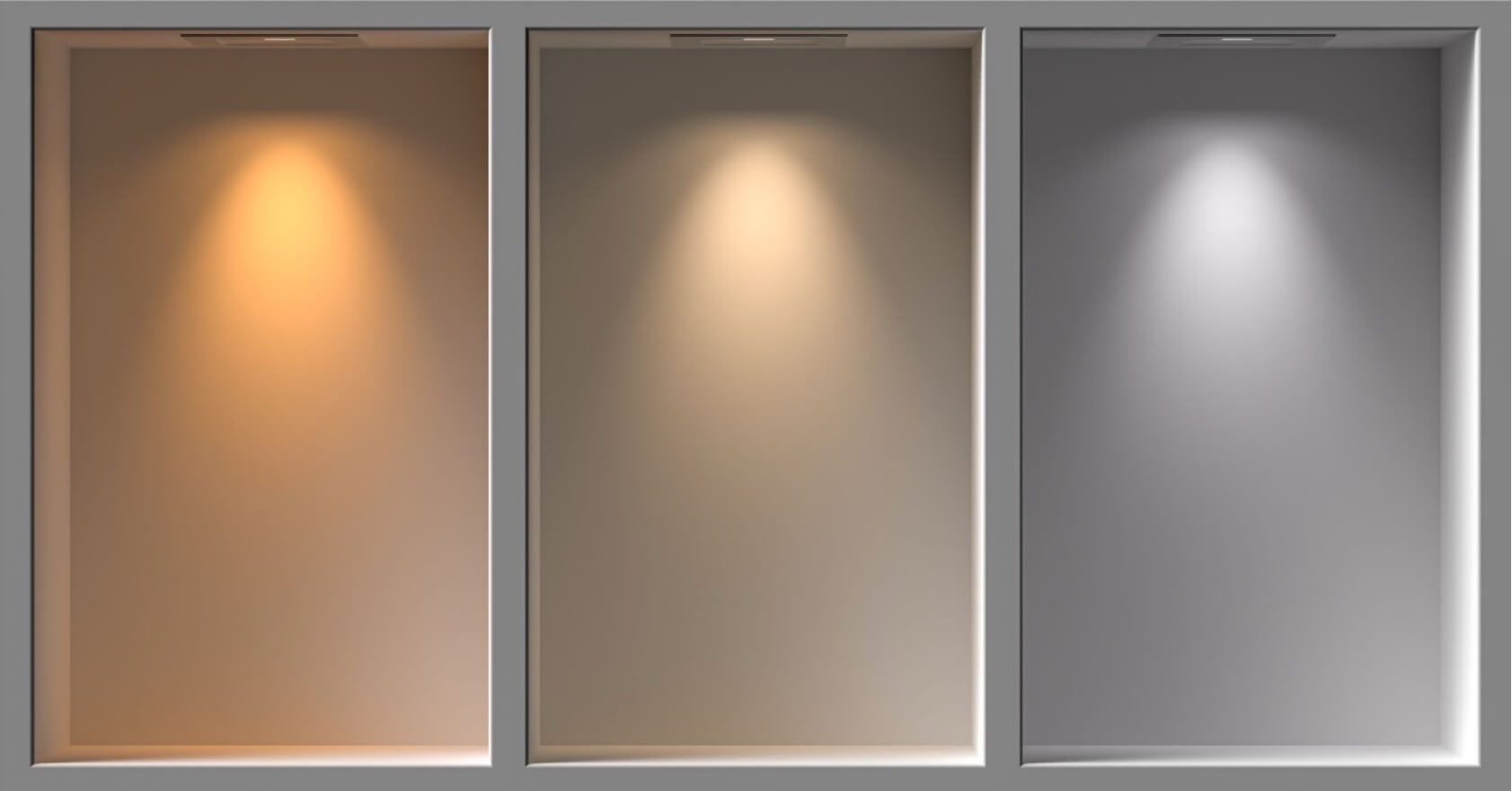
Light is transformative. It changes how you feel, how well you sleep, and whether a room feels cosy or cold. Want your bedroom to feel relaxing or your home office to keep you focused? The trick is simple: pick the right light colour, and your space won't just look better, it'll feel better too.
Key Takeaways
- Warm light (2700K-3000K) promotes relaxation and supports natural sleep cycles, making it ideal for bedrooms, living rooms, and dining areas where you unwind.
- Cool light (4000K-5000K) enhances focus and alertness, perfect for home offices, kitchens, and task-oriented spaces where productivity and accuracy matter.
- Colour temperature affects mood and colour perception; warm light enhances reds and woods, while cool light accentuates blues and whites, transforming how your space feels.
What is Colour Temperature?
Colour temperature measures the appearance of light, from warm yellow to cool blue, using the Kelvin (K) scale. This isn't about how hot the bulb gets, but rather the colour of light it produces.
Lower numbers on the Kelvin scale (2700K-3000K) create warm, yellowish light similar to traditional incandescent bulbs or sunset. These create cosy, relaxing environments.
Higher numbers (4000K-6500K) produce cooler, bluish light that resembles daylight. These promote alertness and are ideal for task-oriented spaces.
Most home lighting falls somewhere between 2700K and 5000K, with each range serving different purposes.
|
Kelvin Range |
Light Appearance |
Similar To |
Best For |
|
2000K-2700K |
Very warm white |
Candlelight, sunset |
Intimate spaces, bedrooms |
|
2700K-3000K |
Warm white |
Traditional incandescent |
Living areas, dining rooms |
|
3000K-3500K |
Soft white |
Halogen lighting |
Versatile use, bathrooms |
|
3500K-4000K |
Neutral/cool white |
Morning sunlight |
Kitchens, workspaces |
|
4000K-5000K |
Cool white/daylight |
Midday sun |
Offices, detailed tasks |
Why Choosing the Right Colour Temperature Matters
The impact of light temperature goes beyond aesthetics. Research shows light directly influences our biological rhythms, alertness levels, and mood.
Warmer lights (2700K-3000K) allow our bodies to produce melatonin naturally, supporting healthy sleep cycles. Recent studies indicate that keeping evening light below 10 lx melanopic EDI helps maintain natural sleep patterns.
Cooler temperatures (4000K-5000K) promote alertness and concentration. Studies published in Frontiers in Public Health confirmed improved task performance under cooler lighting compared to warmer options.
Beyond biology, colour temperature affects how we perceive spaces and objects:
- Warm light enhances reds, oranges, and woods
- Cool light accentuates blues, greens, and whites
Choosing appropriate lighting for each room creates spaces that not only look better but actually function better for their intended purpose.
Room-by-Room Colour Temperature Recommendations
Living Room & Bedrooms
Recommended: 2700K–3000K (Warm White)
Living rooms and bedrooms serve as retreats where we relax and unwind. Warm lighting creates a cosy, inviting atmosphere that complements these activities perfectly.
The science supports this choice too. Research recommends keeping evening light below 10 lx melanopic EDI to support healthy sleep cycles. Warm light naturally contains less of the blue wavelengths that suppress melatonin production.
Our living room lighting collection includes perfect options for creating this warm ambience, while our bedroom lighting solutions are designed to support restful sleep environments.
Pro tip: Install dimmers to adjust brightness based on time of day and activity.
Kitchen
Recommended: 3000K–4000K (Neutral to Cool White)
Kitchens demand functional lighting that enhances visibility for food preparation and cooking. Studies show that cooler, brighter light improves task performance and alertness.
During daytime cooking, aim for lighting that provides adequate brightness at eye level to support alertness and accurate food colour perception.
Our kitchen lighting range balances functionality with style, ensuring your kitchen is both practical and beautiful.
Pro tip: Combine overhead lighting with under-cabinet lights to eliminate shadows on work surfaces.
Bathroom
Recommended: 3000K–4000K (Neutral to Cool White)
Bathrooms benefit from lighting that accurately renders skin tones while providing clear visibility for grooming tasks. A neutral to cool white light offers the best colour accuracy.
For nighttime use, consider a secondary, very warm light source (around 2700K) to avoid disrupting your circadian rhythm during late visits.
Browse our bathroom lighting collection for fixtures that combine functionality with style.
Pro tip: Install lights around mirrors to eliminate unflattering shadows when applying makeup or shaving.
Home Office
Recommended: 4000K–5000K (Daylight)
Home offices require lighting that promotes alertness and concentration. Research confirms that exposure to cooler colour temperatures improves alertness and cognitive performance.
During work hours, aim for brighter illumination to reach the recommended 250 lx melanopic EDI target that supports daytime alertness and productivity.
Find the perfect task lighting in our office lighting selection to create a productive workspace.
Pro tip: Position your desk near a window for natural light during the day, supplemented by artificial lighting that mimics daylight.
Dining Room
Recommended: 2700K–3000K (Warm White)
Dining spaces benefit from warm lighting that creates an intimate, welcoming atmosphere. Warm light flatters skin tones and food presentation, making meals more enjoyable.
Pendant lights or chandeliers above the dining table not only add style but also provide focused illumination where it's needed most. Explore our dining room lighting options for fixtures that make every meal special.
Pro tip: Add a dimmer switch to adjust the ambience from bright family breakfasts to intimate dinner gatherings.
Hallways & Staircases
Recommended: 3000K–3500K (Neutral White)
Transitional spaces like hallways need adequate lighting for safety and navigation. A neutral white provides clear visibility without being too stark or institutional.
For evening use, lower brightness warm lights help maintain safe passage without disrupting sleep patterns. Our hallway lighting collection offers solutions that balance safety with style.
Pro tip: Consider motion-sensor lights that provide illumination only when needed, improving energy efficiency.
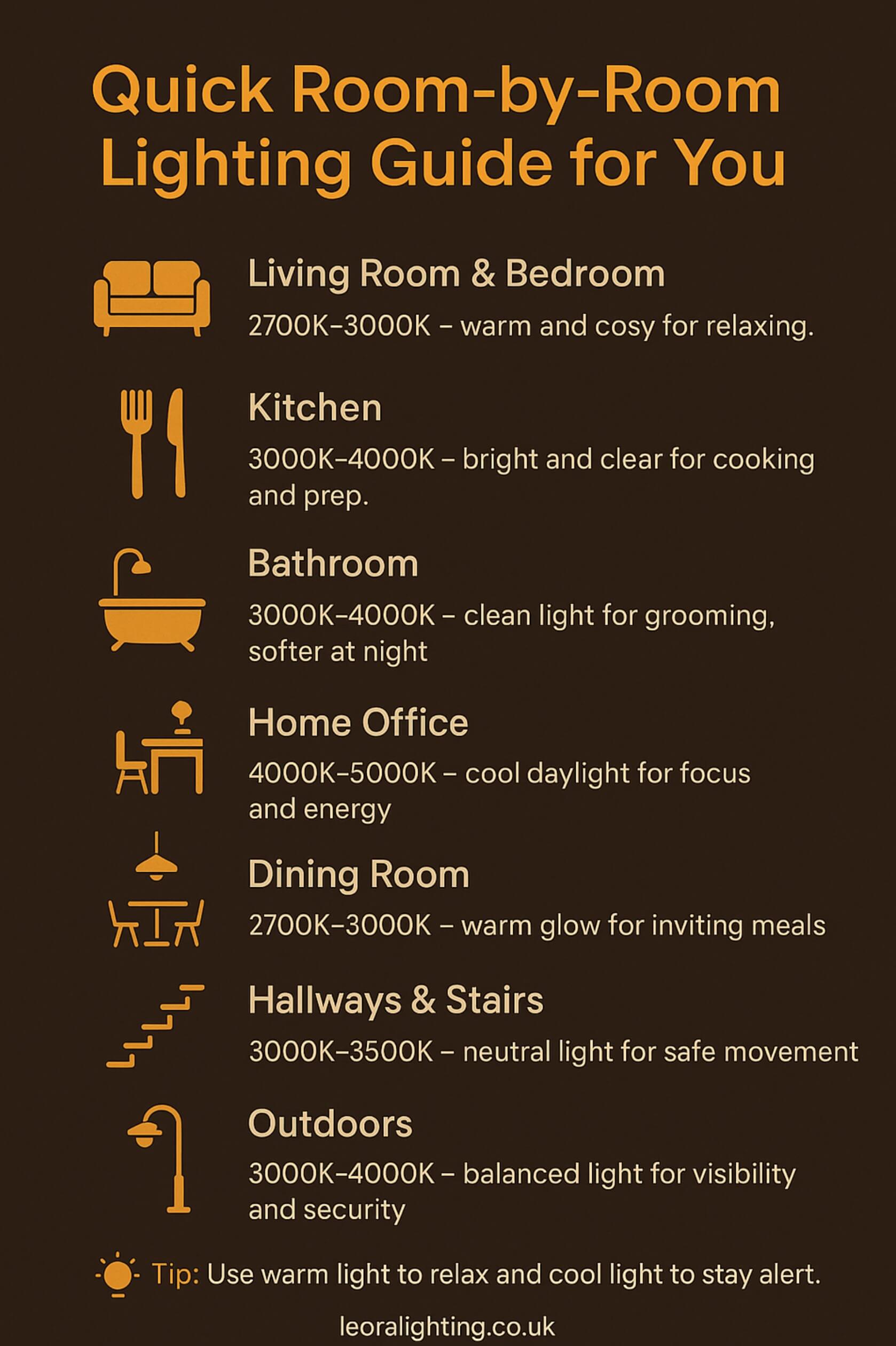
Outdoor Spaces
Recommended: 3000K–4000K (Neutral to Cool White)
Outdoor lighting serves multiple purposes: security, visibility, and ambience. Neutral to cool white light provides clear visibility around entryways and paths.
Weather-resistant fixtures are essential for outdoor applications. Check out our outdoor lights collection for durable options that enhance your home's exterior.
Pro tip: Layer lighting with a combination of path lights, accent lighting for landscaping, and security lighting for entrances.
Kelvin Ratings & Colour Perception
How light affects our perception of colour is fascinating. The same room can look dramatically different under various colour temperatures.
Warmer light (2700K-3000K) makes reds, oranges, and yellows more vibrant while slightly muting blues and greens. It enhances wood finishes and warm materials, making spaces feel cosier and more inviting.
Cooler light (4000K-5000K) makes blues and greens pop while slightly flattening reds and oranges. It enhances white and metallic surfaces, making spaces feel cleaner and more alert.
This effect explains why the same paint colour can look different in the store versus your home, or why clothing colours may appear different under changing light conditions.
Practical Tips for Selecting Lighting
Finding the perfect lighting for your home doesn't need to be complicated. Here are some straightforward guidelines:
- Match the function first: Consider what you do in each space. Reading, cooking, and relaxing all benefit from different lighting temperatures.
- Layer your lighting: Combine ambient (general), task (focused), and accent (decorative) lighting for flexibility.
- Consider CRI (Colour Rendering Index): This measures how accurately a light source shows colours compared to natural sunlight. For homes, aim for CRI ≥80, with 90+ being ideal for spaces where colour accuracy matters.
- Think about timing: Ideally, use cooler lights during active daytime hours and warmer lights in the evening to support your natural sleep cycle.
FAQs
Do LED lights with warmer Kelvin make you sleepy?
Warm LED lights don't directly cause sleepiness, but they avoid suppressing melatonin, your body's natural sleep hormone. This makes them ideal for evening use when you want your body to prepare naturally for sleep.
Can I mix colour temperatures in the same room?
Yes, strategically mixing temperatures can create layers of light for different activities. Keep ambient lighting consistent while varying task lighting based on specific needs. Just avoid dramatic differences that might create jarring visual transitions.
What happens if I choose fewer fixtures in warm tone versus more fixtures in neutral/cool tone?
Fewer warm fixtures might create a cosy but potentially dimmer environment, while more neutral/cool fixtures increase brightness and alertness but might feel less intimate. Balance is key, with brightness and placement being as important as temperature.
Do colour temperatures affect how true colours appear?
Absolutely. Higher CRI bulbs show colours more accurately regardless of temperature. However, warm light enhances reds/oranges while cool light accentuates blues/greens. For colour-critical tasks, look for high CRI bulbs (90+).
Isn't daylight (6500K) always best?
Not always. While daylight bulbs improve task visibility and alertness, they can create harsh environments for relaxation and evening use. They're excellent for workspaces and hobbies requiring colour accuracy, but often too stimulating for living areas.
Does brightness (lumens) matter more than Kelvin?
Both matter equally but differently. Kelvin affects the atmosphere and biological responses, while lumens determine if you have enough light to perform tasks comfortably. A perfect colour temperature at insufficient brightness won't serve your needs.
Conclusion
Here's what to do now: Look at the lights in your home right now. Are they helping or hurting? Your bedroom might need warmer bulbs. Your kitchen could use something brighter. Small changes make a big difference.
Need help picking the right lights? Check out our lighting collection or talk to our team. We'll help you find what works for your space and your budget.
Sources
- https://www.nature.com/
- https://journals.plos.org/
- https://www.frontiersin.org/
- https://pmc.ncbi.nlm.nih.gov/
- https://www.sciencedirect.com/